




Three different pieces of information
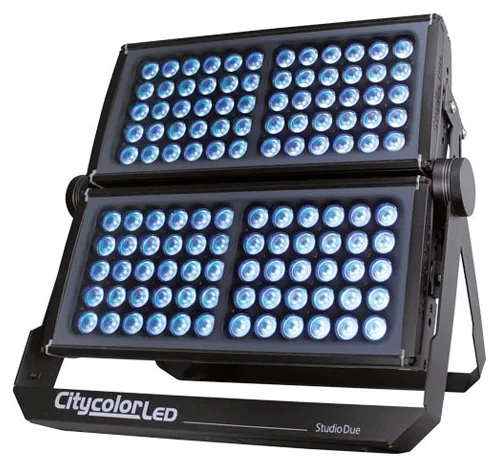
Lumens describe luminous flux. Lux describes illuminance on a surface. Angle describes spread. A higher-lumen fixture need not deliver more lux at a given distance if it spreads light more widely.
Simple geometry
For a circular beam perpendicular to a flat surface, diameter is 2 × distance × tan(angle/2). The tool below shows that idealised geometry. An oblique angle produces a different footprint; real edges are not perfectly sharp.
Read the photometric document
Compare data at the same zoom, colour and distance. Beam and field angles can describe different intensity boundaries. Use manufacturer photometric data for the actual design.
Prepare these details
Your discussion-preparation list. Checking items is not a technical inspection or approval for use. Stored only in this browser.
Explore the principle
Change the angle. See the difference
A geometric model of a circular beam perpendicular to a flat surface.
Diameter = 2 × distance × tan(angle/2). Does not calculate lux, uniformity or laser safety.
Two more useful answers
Does the tool calculate lux?
No. It only calculates idealised beam diameter.
Does twice the distance mean twice the diameter?
Yes, in this geometric model at the same angle.
Sources and further reading
Editorial summary · checked 11 September 2026. International guidance provides technical context, not a statement of Croatian regulations. Current instructions for the exact model take precedence.
















 PANGOLIN LASER SYSTEMS · LUMILASSoftware, control & safety


